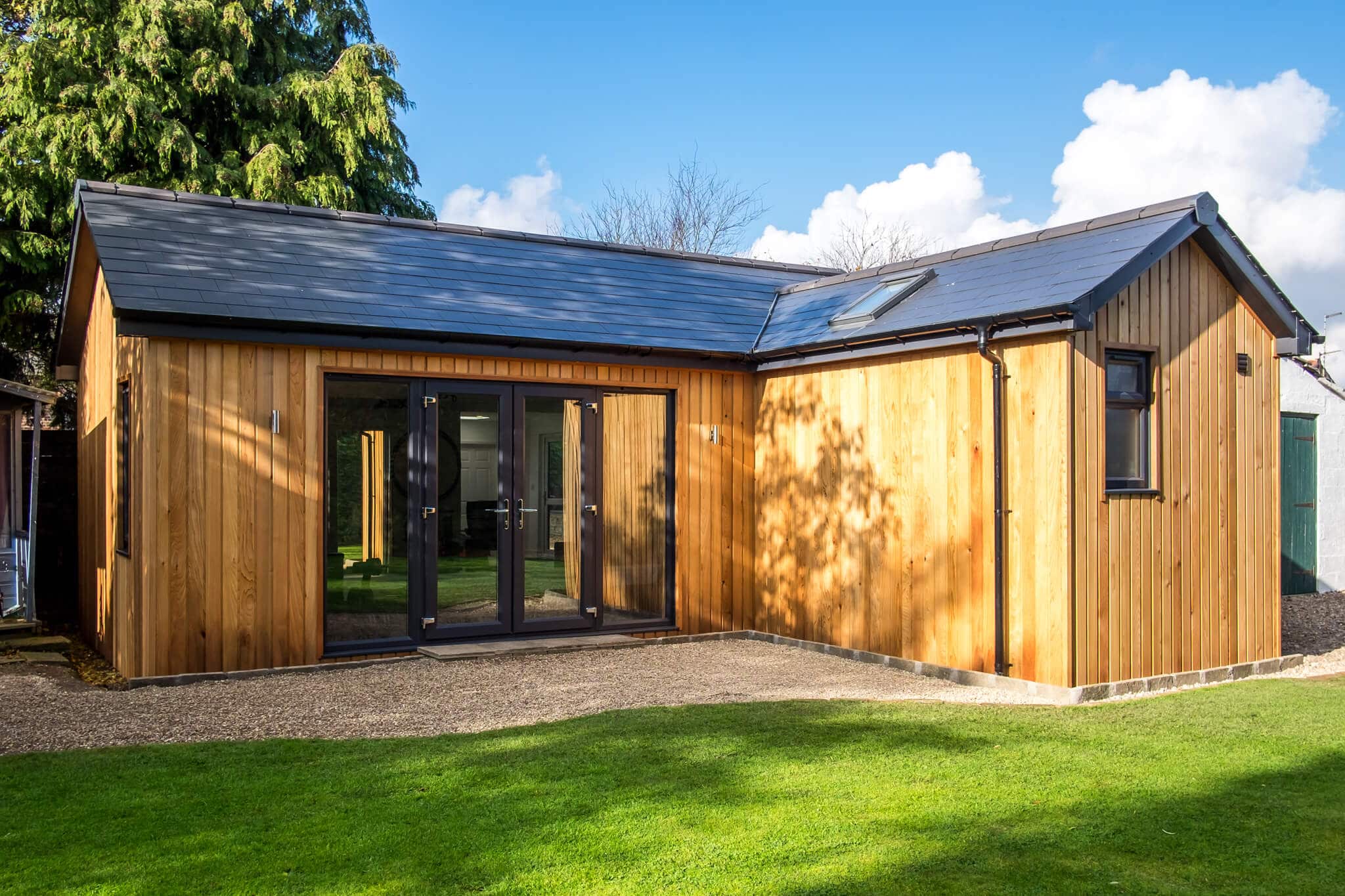
When it comes to building a garden room, we receive many questions on all aspects of the building’s construction. One of the most common questions we hear is about the quality of SIPs on the market today and what to look for in SIPs manufacturers.
We’ve put together a list of the most important points you need to check before having your garden room built with SIPs. You’ll find this information later in the article. To start out, we’ll explain what SIPs are and more!
What are SIPs?
SIPs stands for structural insulated panels that are used to build walls, ceilings, and the floors of garden rooms and other types of buildings. The panels are used instead of traditional building methods, which use lumber framing and insulation. SIPs are very strong, durable, and energy-efficient.
These construction panels are not new; in fact, they’ve been around for almost one hundred years. They were invented by the Forest Products Laboratory in Madison, Wisconsin. They were used by a student of Frank Lloyd Wright, Alden B Dow, who experimented with SIPs in the 1950s. In the past few years, SIPs have gained in popularity due to their flexibility and formability. The panels are used in a wide range of residential and commercial projects.
SIPs are made of rigid core foam, which acts as an insulator. The foam is sandwiched between OSB panels (oriented strand board). The foam is usually made of expanded polystyrene (EPS). However, they can also be made from polyurethane, polyisocyanurate, or compressed straw-core insulated panels. The panels can be used to form floors, walls, and roofs for residential and light commercial buildings.
The SIPs panels are manufactured in strict factory environments and can be made for specific purposes and projects. The panels create a building system that’s cost-effective and energy-efficient. Buildings constructed with SIPs are very strong, which makes this a popular building material for garden rooms and other types of buildings.
What are the Benefits of Using SIPs?
SIPs provide many benefits when it comes to building construction. You can enjoy these same benefits with a garden room built with SIPs:
- Panels can be used for roofs, floors, and walls.
- Roof trusses can be eliminated, which means there’s more space beneath the roof.
- SIPs are superior to traditional wood framing (they’re stronger and don’t shift as much)
- Buildings constructed with SIPs are more energy efficient.
- SIPs can be combined with other building materials, including brick, block stone, tiles, slate, wood, steel, and glass.
- SIPs offer more flexibility when it comes to creating unique structures.
- Building with SIPs can shorten construction time.
- No specialised tools are needed when building with SIPs.
- Buildings created with SIPs are free of drafts and cold areas (they’re more airtight).
- Labor costs are reduced when using SIPs
- A building constructed with SIPs is quieter than a building made with traditional wood framing methods.
What About Sustainability & SIPs?
Are structural insulated panels actually sustainable? This is another common question we hear often. More people are concerned about the environment these days and want to ensure their structures are more eco-friendly. You’ll be happy to learn that SIPs are sustainable.
The panels are made with non-toxic foam between a skin of OSBs, which are sourced from fast-growing trees. What’s more, the panels only use about half the lumber of traditional wood framing. This means fewer trees are used to create SIPs.
In addition, SIPs create a building envelope that offers continuous insulation, and the building is airtight. This means a garden room built with SIPs will be more energy efficient. It will cost less to heat and cool a garden room made with structural insulated panels.
The panels also reduce construction waste and help save natural resources. The overall footprint of a garden room made with SIPs is much lower than using traditional construction methods.
How Strong are SIPs?
This is a common question and a concern many people have when it comes to using SIPs for construction. The fact is that the panels are stronger than traditional wood framing. SIPs buildings have survived natural disasters such as hurricanes, while other buildings simply disintegrated into splinters.
The reason SIPs are so much stronger is that they are load-carrying. The weight of the structure is carried on the entire building shell rather than on the frame studs. This is the very reason that SIPs buildings are better able to survive natural disasters such as hurricanes.
Research conducted on the panels has shown that SIPs can carry over three times as much resistance shear stress as a traditional wall. This makes SIPs the building material of choice for walls and roofs.
What to Look for in a SIPs Manufacturer?
Now, we’re ready to get on to the next point—what to look for in a SIPs panel manufacturer. Here are some of the most important points when choosing a manufacturer:
- Look for SIP manufacturers that have STA (Structural Timber Association) approval and UKAS approved accreditations.
- Other accreditations to look for include: CATG, which certifies the design, manufacture, storage, distribution, and sale of timber frame and SIPs buildings. (Without this certification, your SIPs are not certified by the manufacturer).
- Look for manufacturers that use compression and racking tests.
- SIP manufacturer’s timbers should have the CE mark, as well as PEFC registration.
- A SIPs manufacturer should have panels that have a very low u-value (the rate of heat transfer through a structure—the lower the value, the better insulated the building will be).
- The manufacturer should go through regular audits and conduct batch testing to ensure product integrity.
It’s clear that structural insulated panels offer many benefits over traditional construction materials and methods. Not only are the panels more sustainable, but they’re also stronger, carry lower costs, and they’re cheaper to install.
Garden rooms constructed with SIPs are an excellent solution for anyone who would like to add more space to their home. The panels make it possible to build just about any type of garden room. The construction will be durable, lasting for years. Plus, installation is easy and fast.
If you’re interested in a garden room constructed with SIPs, then contact us today! We’ll answer your questions about SIPs and share information about our amazing garden rooms!